
Latourell Falls, Columbia River Gorge, Oregon
“As one of my intelligence community sources says, we need to eliminate MICE. By that he means Money, Ideology, Compromise, Ego, the common denominators of all leaks. In other words, leaks will persist as long as human nature does.”
Quote from article, “How to Turn Off WikiLeaks;” Keith Thomson Reporter, Huffington Post, 11-29-10 04:00 PM
**Money**Ideology**Compromise**Ego**
Reportedly more than 2 million users on the military’s secret internet network (Siprnet). This was an information leak and not a breach of internet security (hacking), Secretary of State Hillary Clinton said today. Undermining world leadership in one fell swoop — simply human nature?
Comments Off on WikiLeaks: Simply human nature? | tags: cables, culture, human connection, human interest, human nature, ideology, intelligence community, international, Latourell Falls, leaks, life, Lifestyle, nature, news, people, philosophy, Photography, Politics, secret internet network, secret U.S. cables, story, WikiLeaks, words, world culture, world news | posted in Lifestyle, News, Politics, World Culture

Union Station, Washington, D.C. — Curiously, we can take trains without intrusive body searches.
Finally, an issue we can all agree on. Seriously, it’s heartening to see the impact of public opinion. Those that have been standing up for citizen rights across the country are already making tomorrow’s National Opt Out Day campaign a success. Government officials are listening. Participants, you are encouraged to ask for your pat down in public and be heard, if opting out of using the full body scanner.
What should have been a statewide story took national stage yesterday, when Secretary Janet Napolitano from the Department of Homeland Security and Senator Frank Lautenberg, Chairman of the Senate Homeland Security Appropriations Subcommittee, announced the expansion of the ‘If You See Something, Say Something’ campaign across New Jersey. The press conference turned into an explanation of situation vs. process in TSA security screening methods as much as a PR rollout. The brainchild of the NYC Metropolitan Transportation Authority, the program will be implemented nationally in the coming months.
N.J. government officials are encouraging air travelers to ‘opt out’ tomorrow.
Federal Talking Point/Defense: Umar Farouk Abdulmutallab’s attempt to detonate an explosive sewn to his underwear on a flight bound for Detroit from Amsterdam on Christmas Day 2010.
Fair Citizen Retort: Are these types of credible security threats coming from within our borders, or should we be focusing on security overseas?
Richard Reid, the British shoe bomber, went undetected with a similar explosive at Charles De Gaulle International Airport in Paris 3 days before Christmas in 2001. He is the reason we take off our shoes, when going through airport security.
Get Involved: There are plenty of ways to get involved. A good place to start, send a letter to Congress with a few clicks at optoutday.com site.
Other Related News:
- Yesterday, President Obama asked if there is a less intrusive method for TSA officials to conduct security screenings, while defending current procedures.
- Excerpt: Passenger Account (see full story at newson6.com) Jennifer Pierce, News 9, YUKON, Oklahoma
Bubb said the TSA employee touched her breasts and private areas outside her clothes and then inside her pants. Bubb said she was mortified and had to leave her daughter for about 20 minutes during this process.
“It’s not a pat, it’s a rub. They grip you, and they rub going all the way down your body,” Bubb said
- Excerpt: The Entrepreneur (see full story at latimes.com) Nicholas Riccardi, Los Angeles Times; Reporting from Denver; November 23, 2010
He’s selling TSA-proof underwear
Sales have skyrocketed for a Colorado man who says he doesn’t believe the full-body airport scanners are safe. His briefs and bras are strategically emblazoned with patches made of an X-ray-repelling fabric.
Buske hit upon the idea in January after authorities said a Nigerian air passenger unsuccessfully tried to detonate a bomb in his underpants. That led the TSA to speed its deployment of full-body imaging machines across the country. Buske anticipated an inevitable backlash.
https://travelvibe.wordpress.com/2010/11/17/tsa-body-scan-will-you-say-no-nov-24th-national-opt-out-day/
Comments Off on Opt Out: ‘Want my pat down in public pls.’ | tags: air travel, airport, airport security, body scan, British shoe bomber, citizen participation, citizens, entrepreneur, full body scanner, get involved, holiday travel news, if you see something say something, Lautenberg, life, Lifestyle, Napolitano, New Jersey, nyc, Obama on tsa screenings, opt out day, passenger account, pat down, Photography, privacy, privacy rights, protest, public opinion, public pat down, Richard Reid, safety, security, social trial, story, Travel, tsa, tsa screeners, tsa screenings, TSA-proof underwear, Umar Farouk Abdulmutallab, underwear bomber, virtual strip searches, voice, writing, x-ray | posted in Lifestyle, New Jersey, News, travel, Washington, District of Columbia

Washington, D.C.
Rolling through high-heeled streets,
Shimmering in a photo finish.
Small drops with big ideas,
Ya make that steal, or merely cop a feel?
Too much cotton for mirrors on the flipside of down,
But soaking floats color.
So dragging the horizon like an ephemeral plea,
She teases air from smog.
Small drops, what’s the big idea?
She prays for din to break silence,
Before fancying a prey on thunder.
Pattering in gardens of brick and cities of grass,
She won’t ride lightening to wit,
Why take a bolt, when Sun owns color?

Glasgow, Scotland

San Diego, CA
Comments Off on Raining: The Flipside of Down | tags: commentary, Glasgow, human connection, human interest, human nature, life, Lifestyle, Personal, Photography, poem, Poetry, rain, san diego, story, street photography, Thoughts, Travel, travel blog, Travelogue, travelogues, washington dc, writing | posted in Lifestyle, Personal, travel, Travelogue

Laid out…
Local drum circle on Sunday nights: It’s not in the guidebooks, but, if you are open to spending the evening on a nude beach listening to kettle drum, bongo, and tabla beats, it’s worth checking out. After the sunset, about 100 of us exited in a ritualistic procession led by three men wielding torches and lighting our way down a windy trail of rocks. My friend summarized the evening best:
“I finally understand what this whole peace-love thing is about!”


*Repost
Comments Off on Sunday Night Drum Circle — Little Beach, Maui | tags: beach, drum circle, Hawaii, life, Lifestyle, little beach, live music, local culture, Maui, Music, nude beach, off the beaten path, people, Photography, Recommend, story, Travel, travel blog, Travelogue, writing | posted in Hawaii, Lifestyle, Maui, travel
“If you touch my junk, I’m gonna have you arrested.”
–John Tyner’s battle cry at San Diego International Airport, during an invasive pat down by a TSA screener. And the new punchline for privacy advocates. On his YouTube video that captured the incident, we hear the overhead announcement, “Security is everyone’s responsibility,” as Tyner dubs the phrase.
Tree Trunk — Balboa Park, SD
The instructions: Step into the oversized, closet-like contraption. Place your palms facing out on either side of your head so that your arms are about parallel with your shoulders. Spread your legs shoulder length apart. Now hold still…
If there is any confusion, look around, and you’ll probably see a cutout type drawing that will illustrate the position to assume.
“Is this safe? How much radiation am I taking in?” I asked with a friendly smile, as I stepped into the box a few months ago at Nashville International Airport.
“You are getting more radiation by using your cell phone than going through this machine,” the TSA screener responded, equally amicable.
Questions most are asking: Is it safe for my health? Does it violate my privacy rights?
In the News:
- San Diego, Calif — Monday, 32-year-old local resident, John Tyner, posted a YouTube video of his probing pat down, after refusing a full body scanner and body search at San Diego International Airport. In the video, Tyner offers to go through the metal detector on several occasions and apologizes “for the hassle” following the TSA screener’s pat down. He cancelled his American Airlines’ flight and is now being investigated by TSA. Irony? The clip has received more than 50,000 hits as of this morning. “If I don’t do it, nobody will,” Tyner says in the video.
- New Jersey — Lawmakers are asking airport passengers to refuse the body scan for “National Opt Out Day” on Wednesday, November 24th, one of the busiest travel days.
- Washington, D.C. — Yesterday, two pilots filed a federal suit against the Transportation Security Administration and the Department of Homeland Security, alleging that the full body scans and pat downs are a violation of their Fourth Amendment Rights (protects against unreasonable search and seizure).
Comments Off on TSA Body Scan: Will you say “No” Nov. 24th — National Opt Out Day? | tags: air travel, airport, airport security, DC, flying, Fourth Amendment, full body scanner, human nature, John Tyner, lawsuit, Lifestyle, Nashville, New Jersey, news, pat down, people, Personal, Photography, pilots, privacy advocates, privacy rights, probing pat down, radiaton, san diego, san diego international airport, story, Thoughts, travel blog, travel news, Travelogue, travelogues, tsa, tsa body scanner, washington dc, writing, x-ray | posted in Lifestyle, New Jersey, News, San Diego, CA, travel, Travelogue, Washington, District of Columbia
Tweet from Carnival Cruise Liner, Splendor: In regards to our last post, we wanted to clarify that while some SPAM was delivered, it was never served to guests. —Tweeted November 11, 2010 (day ship docked in San Diego Bay)
San Francisco Examiner; here is the lede: Grazia Gala and her husband, Kishore Pradhan, expected sun, relaxation and rest on their seven-day cruise to Mexico. What happened instead were long lines, cold showers and Spam. –Today’s news
Read more at the San Francisco Examiner: http://www.sfexaminer.com/local/Glad-to-be-back-on-solid-ground-108337454.html#ixzz15SqgfM1f

Comments Off on Did They Serve Spam or Not?? That is the Question. | tags: carnival cruise ship, carnival splendor, Lifestyle, news, people, Photography, san diego, spam, spam served?, Splendor, stranded cruise ship, Travel, travel blog | posted in Lifestyle, News, San Diego, CA, travel
Reunions and cheers welcomed, but no stale Pop Tarts or Spam please!
–Passengers said they waited in line upwards of two hours for such tasty treats!

Above: The 113,000-ton Splendor, one of Carnival Cruise Lines’ largest ships, docks in San Diego Bay around 8:30 a.m. Thursday, after an early morning engine room fire rendered it stranded last Monday.
San Diego Bay, Calif. The plethora of media, Veteran’s Day parade, warm weather and jubilation bathed the popular tourist destination in, excuse the pun, a carnivalesque vibe. People gathered in the hundreds, and a laissez faire sense of community support welcomed passengers back to dry land San Diego style.
Tugboats reined in almost 3,300 passengers on the Carnival Splendor cruise liner from Baja, Calif to San Diego, docking at the Port of San Diego’s B Street Pier Cruise Ship Terminal. The ship departed from San Diego on Sunday, November 7, 2010.


Above: Cindi Wolfe, of Ventura, CA, weaves past the crowd toward her family, who has just disembarked.


Series Below: Jeanne Ralston, age 85, is greeted by daughter, Cindi Wolfe.
Wolfe’s cheerful energy put her in the spotlight. Ralston seemed to be keeping pace with her daughter, taking questions from reporters with thoughtful and animated ease.


Top of Ralston’s wish list: Coffee.

Comments Off on Voyage of the Doomed: Carnival Awaits Spamcationers! | tags: carnival splendor, cruise liner, cruise ship, engine room fire, Lifestyle, people, Photography, port authority, san diego bay, san diego harbor, ship catches fire, Splendor, stranded cruise ship, street photography, Thoughts, Travel, travel blog, writing | posted in Lifestyle, Photography, San Diego, CA, travel
“My son had brought two flashlights, so I think we were the envy of the ship.”
–Passenger Jeanne Ralston

Above: Passengers make their way down everyman’s catwalk as clicks, firing questions, flashes and cheers welcome them home.
Carnival Splendor docks in San Diego Harbor; Thursday, November 11, 2010 (Veteran’s Day), 9:30-11:15 a.m. The morning is warm and breezy and the mood depends on one’s stage role.
North Harbor Drive: 4,500 passengers and crew disembark in small groups as hundreds of family, friends and onlookers wait. On the adjacent artery, Pacific Highway, local residents prepare and gather for the Veteran’s Day parade. Reasons to celebrate abound. The warm breeze

Above: Jeanne Ralston of Ventura, CA, embraces her daughter, Cindi Wolfe. Wolfe’s parents and brother were on the ship.
My son had brought two flashlights, so I think we were the envy of the ship,” Jeanne Ralston, age 85, tells the slew of media with an exaggerated eye roll and flash of smile. Ralston and her husband were sporting dog tags in memory of their son in-law, Navy Commander Duane G. Wolfe, 54, who was killed during duty in Iraq on May 25, 2007. Ralston said that crew members commemorated Veteran’s Day with a gathering that included a large American flag.

Above: Cindi Wolfe welcomes her family home.


Above: Retha Hoeffken of Cypress, CA, waits for her daughter, 29-year-old Heather Hoeffken, who is on the ship with her fiance.
Passengers praised the crew, however, some sensed indecisiveness and a lack of communication from upper management.
Retha Hoeffken said she spoke with her daughter yesterday morning for the first time since the ordeal started for her on Monday morning, when she learned about the fire while browsing the web. Heather told her mother that passengers were not informed that there was, in-fact, a fire on the ship, despite smelling smoke. “When she called me she was crying. She said, ‘I’ve never been this scared.’ They didn’t get any information,” Retha Hoeffken said.
“I’ve been making phone calls to Carnival, and they said everything was great. They said they were being well taken care of, and they had flushing toilets and cold water and cold food… They never asked me her name,” Retha Hoeffken adds. She said that the first thing her daughter wants to do is take a hot shower, upon getting home.

Above: People continue standing along the balconies several hours into the disembarking process. (It was difficult to see if they were passengers or part of the ship’s crew.) Every now then, instructions would blare from the ship’s loudspeakers.

Above: A front and center view attracts an on-going crowd, despite the lack of parking. Plenty of hotels line the other side of North Harbor Dr. San Diego International airport sits a few miles down the same artery and downtown’s Little Italy is a stone’s throw away.


Above: A family is taxied off the cruise ship docks. Bystanders wave and cheer.
“Welcome home!”
“Come back to San Diego!”


Comments Off on Photo Story — Local Take: 4,500 Disembark in SD Harbor | tags: 4500 disembark, carnival cruise ship, carnival splendor, Cindi Wolfe, Duane Wolfe, Jeanne Ralston, Lifestyle, news, Photography, Retha Hoeffken, san diego, san diego harbor, san diego port, stranded cruise ship, street photography, Travel, travel blog, writing | posted in Lifestyle, News, Photography, San Diego, CA, travel, Travelogue

Ocean Beach boasts the longest concrete pier in the West Coast at 1,971 feet. Saturday night a couple of weeks back; Ocean Beach, San Diego, CA.
The night is chilly around 10:30 p.m., but I soon lose myself in the waves slapping against the cliffs (walking backwards and stopping often to do so). The scene changes from couples to family, friends, beer and soda alongside fishing gear. My friend asks a man who is leaving for his bait. We walk a little more than 3/4ths of the pier’s length and set up shop.
Inhale…ahhh… Trite truth: the air is scented with sodium induced crispness! Late night crab fishing is definitely an off-the-beaten-path San Diego experience!

It is Loc’s first time out. He spends an hour fishing, but, like everyone else with whom I spoke, his net comes up empty (except for his bait). But he says it’s fun.

A small cage with mackerel is hooked to the bottom of the net.

The net is tethered with a nylon rope and dropped 40 to 50 feet down.

A group of three men walk passed with their gear. “Catch anything?” I yell.
“Nah, going to Mission Beach!” one of them shouts back.

Louis, his wife and their son often spend weekends fishing. Tonight, he says they caught small lobsters and released them back into the ocean. Size matters! Otherwise, you’ll be fined.
“She likes to get her hands dirty,” he says with a smile, while cocking his head back toward his wife.
An evening after a good rain is the best time to fish, Louis advises.
Update 11/11/10: Spoke with a friend of mine that ended up catching a crab after I left (before midnight).
Comments Off on Late Night Crab Fishing: Size Matters! | tags: crab fishing, culture, fishing, human connection, late night fishing, life, Lifestyle, ocean beach, ocean beach pier, off the beaten path, people, Personal, Photography, Recommend, san diego, Thoughts, Travel, travel blog, Travelogue, travelogues, writing | posted in Lifestyle, Photography, Recommend, San Diego, CA, travel

San Diego, Balboa Park: Photo taken with BB cell phone. Poem inspired by a chance meeting during a morning walk through the rose garden this cloud-ridden week.
Fresh droplets,
Stick out my tongue,
Dewy rose,
My celli captures it beautifully!
Plumes of white brighten the dim sky,
Shades sparkle in pink, cream, yellow, red, green…
Gray palette: Showcase petals and leaves!
Salty drops,
Her hand shakes,
Hushed cords,
No lightning or thunder. Only rain.
“…Sit for a minute?”
Comments Off on Fresh Droplets — Stick Out Your Tongue! | tags: balboa park, human connection, human nature, life, Lifestyle, nature, off the beaten path, people, Personal, Photography, Poetry, rainy day, Recommend, rose garden, story, Thoughts, Travel, travel blog, Travelogue, travelogues, writing | posted in Lifestyle, Personal, Photography, San Diego, CA

Balboa Park, Rose Garden (recommend)
It’s October, and I watch a bee graze the stamen (that thin hair-like stuff in the center) of a pale yellow Julia Childs.
Some blooms have wilted, while other buds flourish — hard to tell if it’s spring or autumn. Isn’t that the case sometimes in life too?
We wilt and blossom in the paradox until nature indicates a clear shift, and we are once again intimate with season.

Comments Off on Between Seasons: Will you blossom or wilt? | tags: balboa park, human connection, human nature, life, Lifestyle, nature, off the beaten path, parks, Personal, philosophy, Recommend, rose garden, san diego, story, Thoughts, Travel, travel blog, Travelogue, two-cents on life, writing | posted in Lifestyle, Photography, San Diego, CA, Thoughts, Travelogue

Sitting at Starbucks…
“You dropped your dollar,” a man behind me in line says as I step away from the register. I thank him, pick it up and take my seat on an armless, cushiony, brown chair.
“That was really nice of him,” the woman sitting next to me comments. I don’t bother opening my book. She tells me she would have returned the dollar too.
Her name is Sandra. She used to be homeless, she says. . “I never thought it would happen to me. I guess sometimes you have to watch what you say.”
We chat for a few minutes. Then I tell her about my blog and ask if she’d be interested in sharing some of her story. She agrees.
Her soft brown eyes set upon mine, and she gingerly pats the back of her afro.
Sandra spent 1½ years on the streets of San Diego starting in December 1990, after getting laid off from her job at Longs Drug store in El Cajon. “I used to go around asking people to give me something to eat. I would never ask for money,” she adds.
Sandra would go to St. Vincent on Imperial Avenue to shower, but she chose not to stay there – too many rules and restrictions.
For her, the streets were more congenial. “Sometimes I was spit at. People would throw things at me. That was just for the first couple of nights. But knock on wood, people were really nice.”
Then on a summer day in 1991, Sandra was near the downtown courthouse, when she recognized an old friend. She called out to her. “She didn’t recognize me at first,” Sandra said. Her friend was in disbelief.
But she offered Sandra a way to put her life back on track: A home. “[She] took me under her wings and got me a job. I guess she trusted me enough to live with her.”
I start asking another question, but Sandra lets me know that this is all she is comfortable sharing. And it is more than enough.
I see Sandra every now and then at the CVS in North Park. She’s a cashier. If I get her register, I end the transaction with: Good seeing you again.
She responds: Good seeing you too.
Or vise-versa. Either way, it’s nice.
Comments Off on Classic Kindness Strolls By — Luck? | tags: homeless, human connection, human nature, kindness, life, Lifestyle, north park, off the beaten path, people, Personal, Photography, san diego, story, story of kindness, street photography, Thoughts, Travel, travel blog, Travelogue, writing | posted in Lifestyle, Photography, San Diego, CA, Travelogue
San Diego, CA — Balboa Park
Museum of Photographic Arts — Photograph from MoPA website.
In between the salty streams we collectively found ourselves laughing.
Last night, the Human Rights Watch Film Festival featured Pushing the Elephant, a film in which the story’s protagonist – 2009 UN Humanitarian of the Year – defiles the face of war by valuing the faces of survival.
During the conflict in Congo, Rose Mapendo’s husband is killed, and she is forced to bargain her 10 children in various ways, in particular her daughter, Nangabire. Through her reunion with Nangabire, Pushing the Elephant seamlessly juxtaposes scenes from the life Rose and her family currently live in a beautiful suburban U.S. neighborhood with the wreckage of surviving the Congolese conflict.
The strength and wisdom Rose gained by forgiving the crimes against her family and community stuns.
After some deliberation with her eldest son, now the man of the household, Rose visits Congo and revisits her memories.
She listens to those left behind, imparts perspective and bestows hope to her community. At one point, while kneeling alongside community members by a small slab of gray stone that marks the grave sight of a mother and wife, Rose says a prayer and thanks God for growing a tree in the space as a sign of rebirth…
The Festival runs thru September 25, 2010. For a full schedule, checkout www. mopa.org.
War exists because people lack love.
— Rose Mapendo
Comments Off on So WORTH It: SD Human Rights Watch Film Festival | tags: balboa park, congo, film festival, film review, human connection, human nature, human rights, human rights watch film festival, life, Lifestyle, Museum of Photographic Arts, museums, off the beaten path, people, Personal, Photography, Pushing the Elephant, Recommend, Rose Mapendo, san diego, story, Thoughts, Travel, travelogues, UN Humanitarian of the Year, world, writing | posted in Film, Lifestyle, Photography, San Diego, CA
San Diego provides a great opportunity for enhancing health and wellness. During a recent trip to Manhattan and Washington, D.C., I was surprise to learn how many friends and acquaintances relate such ideas to L.A. So, I thought a story on health and wellness in the San Diego area was in order.

On a Sunday morning…
Meditation is about connecting with your emotions, Courtney Kimpo, our instructor tells us. About a dozen people, some seated on blankets resting on the bamboo floor and others seated in chairs, prepare to practice meditation (on Tuesday evenings that number jumps to 50 people or more). Flickering candles line the floor before Courtney.
Today, we will go into relaxation, followed by concentration, and heart-centered meditation, she says.
Sounds easy enough.
But sitting in my chair, I am thankful that we are commencing with some stretches at the top of this hour-long session. Having practiced meditation before, I can tell you that well-intentioned surrender to these gentle directives can ignite a misfiring of synapses.
A melodic flute charms the space, and we flow into part one: Relaxation. Relax the muscles in your forehead, your face, Courtney coaxes with soft ease…
Open your eyes slightly and focus on the candlelight or the darker shades of bamboo on the floor, she suggests as the class transitions into concentration. She guides our breath and our attention like a thread. We end the session with a vibration of sounds that crest into a concert of “Om.”
I do not see colors or shed tears of joy, but I feel my heart beat. I sense my spirit. I brush something pure.
After the session, I ask Courtney if she has any suggestions for those of us for whom meditation does not come easy.
“Begin slowly. Begin with patience. Begin with a positive reading — something that brings you inspiration. Try to connect with the joy of your heart center and know that everyone has challenging moments with meditation.”
A few minutes later, back out on Adams Avenue, I see Courtney again. “Do you know what I really want to say?” she asks.
“What?”
“What I really want to say is if you are having a hard time getting into meditation, come to a Pilgrimage of the Heart meditation.”
I smile, and think to myself, see you next week.
Located in Normal Heights (10 minutes from downtown), Pilgrimage of the Heart Yoga studio offers free meditation on Tuesdays and Sundays.
Comments Off on San Diego Health and Wellness: Want to Quiet the Cacophony of Thoughts? | tags: empowerment, health and wellness, human connection, life, Lifestyle, meditation, people, Personal, Photography, pilgrimage of the heart, Recommend, san diego, self awareness, spirit, story, Thoughts, Travel, travel blog, Travelogue, travelogues, writing | posted in Health and Wellness, Lifestyle, Photography, Recommend, San Diego, CA, travel
Some days it feels like I’m chasing tides in rapid recession.Focusing on anchored matter helps bring the shoreline into crisp vision. And once again, I can appreciate nature’s flow en route (and in root). Balance usually returns with an exhaling grin.
West Coast shoreline
Comments Off on Chasing Tides | tags: human connection, human nature, life, Lifestyle, people, Personal, Photography, random thoughts, story, Thoughts, Travelogue, west coast, writing | posted in Lifestyle, Personal, Photography, Thoughts, Travelogue
We all know that city parks are a public service, but Manhattan’s parks add a bit more flare to this concept. Would you expect anything less?

Union Square Park (above)
The weekend before last, some friends and I saw The Merchant of Venice (Shakespeare in the Park) in Central Park staring Al Pacino as Shylock -– a free offering. The moon was full. The night was hot and humid. The stage was minimal, and the costumes were authentic. The trees barely swayed, but the performance and atmosphere charmed the moment. A pseudo 16th century experience in 2010 — kinda cool!
Other fun parks:
Bryant Park — Monday night movies in the summer. Watch a movie on the big screen with hundreds of locals. I like grabbing some eats and finding a table along the perimeter. The evening bids a relaxing and communal local experience. Free.
Washington Square Park & Union Square Park – late afternoon, early evenings, and weekends –- best time for random art, music, and people watching.


Comments Off on NYC Parks: Rockin’ the Summer Freestyle! | tags: Al Pacino, body art, body painting, Bryant Park, Central Park, culture, images, life, Lifestyle, manhattan, manhattan summer, people, Photography, Recommend, street photography, Thoughts, travel blog, Travelogue, travelogues, Union Square Park, Washington Square Park, women, writing | posted in Fashion, Lifestyle, New York, NY, Photography, Thoughts, travel, Travelogue

I’m from the NE, where food preparation is arguably among the best in the country. However, the west coast owns the freshness factor. That being said, the following restaurants boast the preparation that an east coast food snob desires with a combination of ingredients that can only be served up on the west coast. As you probably guessed, the price point reflects the food, but no worries, it’s not rock star style. Keep in mind lunch and happy hour options for a financially savvy dining experience.
Sushi: Hane (Sorry, no website! Dare I say, it’s better than Nobu!)
Location: Banker’s Hill
Atmosphere: Understated. Clean lines with a splash of color.
Fresh, melt in your mouth sushi! Try the negitoro for a culmination of that descriptor.
Modern California Fare: Market Restaurant
Location: Del Mar
Atmosphere: Casual modern elegance. Warm hues that mix well with the selection of fare — unassuming, creatively, and fresh!
The combination of ingredients and subtle flavors will strike any true foodie’s fancy.
Spanish: Tapas Picasso Restaurante
Location: Hillcrest
Atmosphere: Funky and intimate; a happenstance myriad of artwork with an aesthetic rhythm.
Rich textures and food combinations with personalized service and attention to detail. And let’s beat a dead horse — it’s fresh!
Comments Off on San Diego Eats: Local Picks with Freshness and Flavor | tags: culture, Food, food culture, foodie, Lifestyle, Nobu, Personal, Photography, Recommend, san diego, san diego eats, southern california, Thoughts, Travel, travel blog, Travelogue, writing | posted in Food, Lifestyle, San Diego, CA, Travelogue

Agitation – A word that often conjures a negative connotation. Perhaps misunderstood…
The other day my yoga teacher asked the class to agitate their necks while in mountain pose (upward dog) in order to release tension in the neck and shoulders.
Agitation in film photography usually refers to developing negatives or developing an image on photo paper.
Agitation is great for my contact lenses – keeps them clean and scratch free.
In our daily lives, however, “agitation” seems to wear a visor that flashes words like **annoyed**upset**roiled**.
So when my Vinyasa instructor mentioned agitation in the context of yogic practice – the word stood out like a nightgown-clad drag queen in a sacred temple.
And the utterance convened me to reconsider its meaning in my own life. I looked up the entomology and according to Merriam-Webster’s dictionary:
Latin agitatus, past participle of agitare, frequentative of agere to drive — more at agent.
To drive… to direct movement…
Without agitation, would we ever really change? Would we grow? Maybe agitation drives an authentic path.
Comments Off on Agitate Your Senses into Zen? | tags: culture, life, Lifestyle, people, Personal, Photography, Recommend, senses, story, temple, Thoughts, Travel, travel blog, Travelogue, travelogues, world, writing, yoga, zen | posted in Lifestyle, Personal, Photography, Thoughts, Travelogue
Chinatown in Washington, D.C. is today's hotspot for young professionals and graduate students.


Comments Off on Washington, D.C. Hotspot | tags: chinatown, culture, gallery place, hotspot, life, Lifestyle, people, Photography, Recommend, street photography, travel blog, Travelogue, travelogues, verizon center, washington dc, young professionals | posted in Lifestyle, Photography, Travelogue, Washington, District of Columbia
The Speakeasies

Evening Glow
Glasgow has more than 700 pubs – speakeasies that allow you to slip into the day’s social current.
My friend Abi – a 30-something professional city dweller – and a score of locals turned me onto Ashton Lane’s pub scene in Glasgow’s trendy West End, as the real deal and not just a tourist aberration. The cobblestoned pathway, narrow space, iron-rod outdoor seating, green plants and canopy of yellow Christmas lights cajole patronage from the borough’s large population of students and young professionals.
The vibe is laid-back-cool. It’s as if the lane is saying, “No, I did not try, I am fabulous by happenstance, so relax, and have a pint.” And when the temperature rises, beer gardens housed behind some of the pubs become prime real estate.
By the way, Ashton Lane is blocks away from Kelvingrove Park (85 acres). Set in a 19th century Victorian design, the first purpose-built park in Scotland is the choice urban refuge to wind down, people watch, and picnic.
If watering-holes are your thing, reach past the tourist inside and ride on a Glaswegian tradition offered up by a local café owner, Donald Slessor, whose surname and lineage are denoted on the Scottish currency note.
Jump onto the underground – which is one big circuit – and pub hop from station to station until you get back to your starting point. A groom or bride to be usually accompanies the party game – mere semantics. The pints are stronger across the pond, so carry on with forethought.
Like a good ambassador, Slessor also suggests Café Ganolfi (www.cafeganolfi.com) as a “very chill” Sunday morning breakfast joint to nurse that hangover with good eats or a selection from the “huge array of alcoholic drinks.” The café’s polished wood, stained glass window, and informal air make it a popular venue anytime of the day.
Comments Off on Glasgow Speakeasies – A Drink Mate? Part IV | tags: ashton lane, beer, drinking, Glasgow, life, Lifestyle, off the beaten path, Personal, Photography, pub hopping, pubs, speakeasies, travel blog, Travelogue, travelogues, UK, writing | posted in Glasgow, Scotland, Lifestyle, Recommend, travel, Travelogue

Photograph by author
Bursting in with comet speed,
Tailing ethereal escapes,
Folding in and out of state,
The salacious flirt now spins retreat.
Exhales draw breath with renewed interest.
Green pastures bend to golden sandstone with a deadline footnote.
Spontaneous combustion takes the fall.
Sublime surrender in rubble razes ground.
With charming rescue, wildlife rings celestial bodies.
Coincidence swims with shouldered intent.
Accidents pour with pretext.
Either way, love now enters the equation…
Tripping skyward among insanely sunny showers,
Freefalling into a bed of mudded waters,
Eyes open!
Twisting wood and ocean hues are charging the horizon.
Smiling wildly at that spark of green before a setting sun,
Standing like a hanging man released from a parody of fate.
Is that sweat upon brow hovering over a grin?
Yes! The prism discovered its flood of light.
And so it goes, a fall trips spring…
Unearthed reflection now pitches universal color!
Comments Off on Greenspace: Your Natural Flow or a Parody of Fate? | tags: culture, greenspace, human connection, human nature, iao valley, life, Lifestyle, Maui, nature, Personal, Photography, poem, Recommend, Travel, travel blog, Travelogue, world, writing | posted in Hawaii, Lifestyle, Photography, Poetry, Travelogue
A couple of weeks ago, I was at Beauty Bar in Manhattan speaking with a friend and fellow writer. As a New Yorker, he mentioned that the financial crisis seems to be leveling egos and raising existential questions amongst locals. Substantive (ad-lib) chats with a swirl of humility are on the rise again in this financial and cultural hub, according to my friend and active Manhattanite for more than a dozen years.
As spring brings with it renewed life, perhaps ushering comfort into those extemporaneous exchanges with friends and strangers is the blessing.
(Spring Souls)
Can a soul be saved, if another soul waits?
The door you guard grants you passage to life.
You can shake your own hand on the other side.
But what if the shadows stop dancing?
Will you stand vigil?
Or spill into the night?
Do the walls coming down make you feel tall?
Or is it just another lie you fake?
Will you be callus and delete the past?
Perhaps lose yourself in task?
After all, it’s not the end of a life, right?
Can a soul be saved, if another soul waits?
I don’t know, but I will myself to turn the knob… and seek.
Comments Off on Pontificating Stations: Mind the Gap… and Wait? | tags: beauty bar, culture, financial crisis, free will, human nature, life, Lifestyle, love, manhattan, new york city, peronal, Personal, Photography, Poetry, spring, travel blog, Travelogue, travelogues, writing | posted in Lifestyle, New York, NY, Photography, Travelogue

Photograph by author
This poem is about a man I met in a small town in Gujarat, India. His perseverance, humanity, and faith in the face of peril continue to inspire me.
Starry Connections
A barren star reflects his spirit,
But a flooded breath drowns his light.
A windy town plunges the boy,
Gasping, he resurfaces a man.
Life anew tethers his own,
Another vindicates the shells of his soul.
Succumbing to her calm,
He sips the air.
Trembling, he wakes.
Her water too icy to birth life,
Vindication takes a dive,
Still, he pays homage to the roots she anchored.
A flooded breath drowned his light,
But her gales blew him ashore.
And as his feet connect to sand,
He is reborn.
No longer does he flail in her starry springs.
He understands that her platform is meant to celebrate life.
Comments Off on Starry Connections: Gujarat, India | tags: beach, chorwad beach, culture, Gujarat, human connection, India, life, Lifestyle, man, people, Personal, Photography, Poetry, reality, story, Thoughts, Travel, travel blog, Travelogue, writing | posted in Gujarat, India, Lifestyle, Photography, Poetry, travel, Travelogue
A reminder that a fresh palette lends itself to the authenticity of color and intent in stroke…
Philadelphia, PA, November 4th, 2008: The impromptu citizen urge to parade Obama’s victory along Broad Street — where the architectural awe of the country’s largest city hall drops back like an anchor dressed in Victorian splendor (courtesy of Scottish architect John McArthur, Jr).

Photograph and Image by author
Comments Off on Impressing Color: Red, White, and Blue | tags: barack obama, election night 2008, human connection, human interest, human nature, life, Lifestyle, obama, people, Personal, philadelphia, Photography, Politics, story, street photography, streets, travel blog, Travelogue, travelogues, writing | posted in Lifestyle, Philadelphia, PA, Photography, Politics
January 20, 2009 – Washington D.C. – Inauguration Day
A splash of ‘tongue-and-cheek’ fashion for political, tabloid, and hard news junkies.
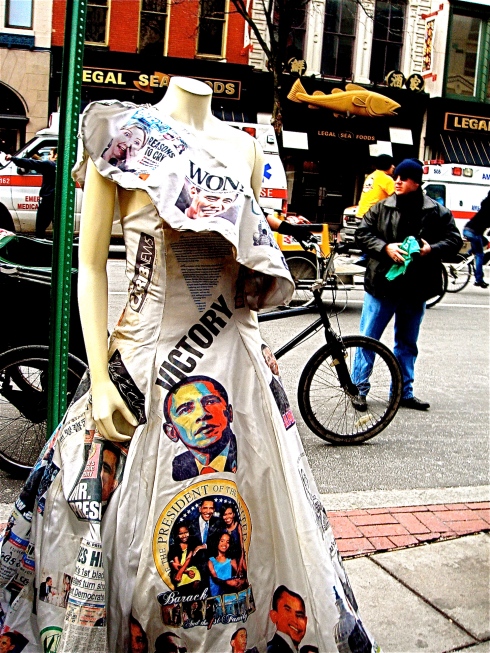
Washington, DC: Fashion Flirts with Political Media as the Streets Celebrate Inauguration Day.
Comments Off on Washington, DC: Wow! The Model Inaugural A-dress | tags: 2009 inaugural day, art, barack obama, Fashion, inaugural fashion, media fashion, model, Photography, Politics, street photography, travelogues, washington dc | posted in Lifestyle, Photography, Politics, travel, Travelogue
Election Night – Philadelphia, PA
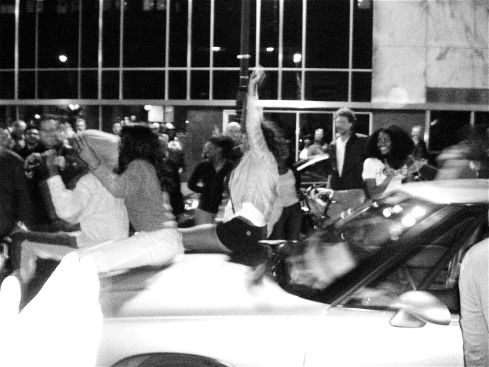
Exhales and Elation: Moments after Obama's Victory; Broad Street, Philadelphia, PA
I remember tuning into MSNBC in my living room… a few minutes before 11 p.m., and all indicators point to another long night. During the last presidential election in 2004, I stayed up until 6 a.m. — futilely praying that Kerry could tow-the-line all the way to the White House — before giving into sleep as commentators continued grappling with words like “to close to call” or “electoral ballots.”
So sure, I step away for a moment… just one moment. In the den my husband and friend are having a chat and enjoying the Philadelphia skyline. All of the sudden, I hear a nonchalant announcement that Barack Obama is our president-elect. Immediately, the cameras cut to Obama Headquarters and the crowd at Grant Park in Chicago. It’s really happening… Shock… complete disbelief… a breathless flood of collective, connected pride… We won! We illustrated to the pundits and talking-heads our desire to take active stewardship in our future.
Humanity, reason, truth, and empowerment: Harvest it, and we welcome democratic participation.
Push us, and we welcome democratic participation. But, it may not be pretty, as sampled during the 2006 midterm-elections.
Our country’s indispensable ideology — many times muddled in the championed capitalism of the “American Dream” — is our Constitutional allegiance to human rights. Perhaps the last 8 years reminded Americans of what we could lose…
Politicians, take notice and raise the bar. Our forefathers painstakingly provided the most just and malleable blueprint to-date so that our empire does not succumb to the pages of history as another swinging pendulum.
We are beings of instinct. If presented with talking points that try and spin split peas into pretty-green candied yams, we’ll either push them aside or spit them up. Why? Not because we are fearful of the awful taste. We just don’t like being lied to…
Remember that old adage:
Fool me once, shame on you, fool me twice and… uhhh… yeah that’s it!
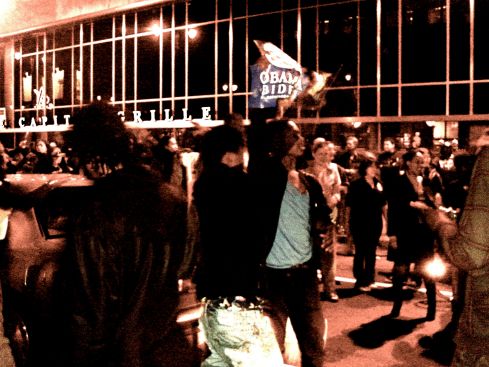
The CLOCK STRIKES 11! Freedom Rings Steps from City Hall Philadelphia
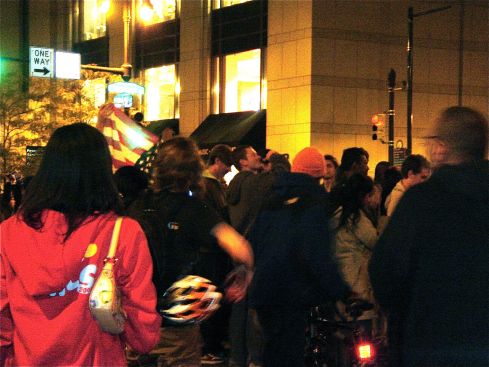
And We Believe in Something, in Someone... Yes We Can!
Comments Off on HOPE: A PROCLAMATION OF EMANCIPATION FROM STATUS QUO | tags: barack obama, Broad Street, candid reactions, City Hall, culture, election night 2008, election night photos, human connection, human nature, images, life, Lifestyle, november 4th 2008, philadelphia, Photography, Politics, story, street photography, Travelogue | posted in Lifestyle, Philadelphia, PA, Photography, Politics, Thoughts
The city’s independent music scene flaunts raw talent that demands notice on the streets and on stage. In August 2008, Glasgow was designated UNESCO City of Music – making it the 3rd city in the world to covet the distinction after Seville and Bologna.
Walk into a reputable venue and experience what the buzz is about.
I decide to visit King Tut’s Wah Wah Hut – where the band Oasis was discovered – on a Saturday night. The stage rests on the pub’s second floor in a cozy, dim-lit, space with a standing-room capacity of a few hundred people.
In 2006, New York Magazine touted King Tut’s as the 7th best way to “Follow Your Bliss,” in its Top 50 places to visit worldwide. And as it is Scotland music mogul Craig McGee’s first progeny, the going-concern continues heralding quality performances.
Talent reps screen and audition bands prior to green-lighting shows, and playing a gig here lends musicians a certain amount of legitimacy.
“The whole ethos of this place is that this is how [live music] venues should be run,” says Laura Rooney, the on sight rep.
On Stage, a trio of boys, The Ghosties, play for an audience of 150. Reminiscent of The Killers, the band coalesces electric and acoustic sounds that set the mood for strong vocals and pithy lyrics rendered by an animated frontman. As the lads close the set and exiting stage left, the crowd chants, “We want more! We want more…”
Not bad for an unsigned band or a pub-side concert.
Bar Fly (barflyclub.com) and 13th Note (13thnote.co.uk) also book quality talent. Pick up The List, Glasgow’s weekly entertainment guide, for performance information.
Culture, globalization, and music: What is the connection?
“We at UNESCO believe that culture not only makes an economic contribution, it provides meaning and a sense of identity and continuity that is integral to the life of all societies,” said the Director-General during the ceremony. “An understanding of culture helps communities grapple with the challenges of globalization, by preserving the values and practices that define their way of life, and by promoting respect for other cultural traditions and ways of life. It represents a way of engaging with cultural differences and building social harmony, of making people of all ages and origins feel involved,” Mr Matsuura added.
Source: Unesco Press Release
Comments Off on Glasgow: THE Music Scene for Those in the Know – Part III | tags: concerts, culture, Glasgow, images, indie-music, King Tut's Wah Wah Hut, life, Lifestyle, Music, music venues, new bands, off the beaten path, Personal, Photography, Scotland, story, Travel, Travelogue, travelogues, UK, UNESCO, writing | posted in Glasgow, Scotland, Lifestyle, Music, Photography, Travelogue
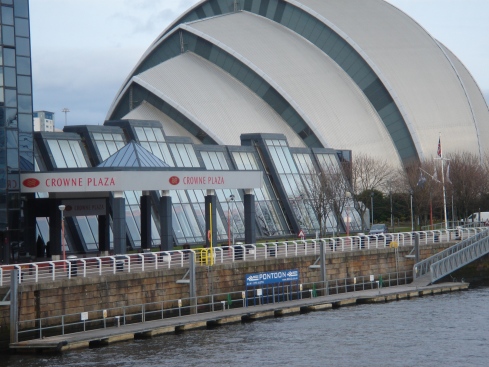
The People
My quasi Type A persona continues to thaw, and it may have something to do with Murphy’s Law, which states, “If anything can go wrong, it will.”
Around here, Murphy is considered an optimist. Not following?
Maybe a page from a life-long Glaswegian who was honored last year with the MBE (Member of the Most Excellent Order of the British Empire) medal – the first stage to knighthood, will clarify.
As we sit in his Strathclyde University office, just off of George Square – the heart of the city, Jim Wilson shares with me his encounter with a short, silver haired, homeless woman one evening on his way to the train station.
“‘Do you have any change to spare, son?’” said Wilson, relaying her words. Wilson answered, “no” and met her stare for what seemed like 10 minutes, he recalls.
With eyes dancing he continues: Then, she started to laugh and then circled around me and exclaimed, ‘No?! Neither do I!’
“You see life in all its fullness,” Wilson says. “It’s got the good, the bad, and the ugly, and that is the strength of Glasgow. Whatever your condition you will be accepted.”
Comments Off on Glasgow: Glaswegians and Murphy’s Law – Part II | tags: culture, Glasgow, human connection, human nature, life, Lifestyle, people, Personal, Photography, Scotland, story, street photography, Travel, travel blog, Travelogue, travelogues, UK, wickedly funny, writing | posted in Glasgow, Scotland, Lifestyle, Photography, Travelogue
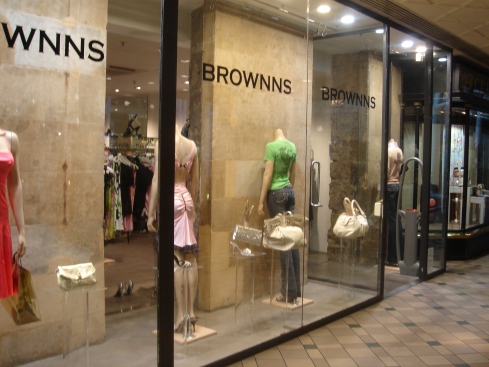
Glasgow: Fashionista Heaven
Glasgow, Scotland imbues the culture and mystique of old-world Europe with a hip and unpretentious panache and serves the concoction against a backdrop of rustic and gold sandstone buildings and green space (translation: 70 city-parks, golf, and mountainside views) on an uptown happy-hour budget.
The people are friendly, unassuming and wickedly funny. And while exploring the city in the brisk March air, conversations with friends and some interesting natives, offer up the inside-scoop on Glaswegians, speakeasies, and hot, in-the-moment music and fashion scenes that seem to be a European secret.
The cosmopolitan’s official badges of honor include winning last year’s bid to host the 2014 Commonwealth Games and a designation as “European City of Culture” by the European Union in 1990. But on the streets, in the pubs, and in international headlines, it is Glasgow’s music scene – launching bands like Franz Ferdinand and Snow Patrol – and fashion districts – ranking 2nd only to London in the U.K. – that steal the spotlight.
And since it continues to be less expensive than neighbors Edinburgh, Dublin, and London, visiting Europe this summer is doable, even with an anemic dollar.
First settled in 6th century AD, Glasgow has reinvented itself more times than Madonna. America’s independence phased out the city’s tobacco trade and signaled a more than century-long industrial revolution prospering in textiles, cotton, steel and shipbuilding – reaching its economic zenith in 1900.
Today’s Glasgow has dusted off its industrial image and Victorian architecture and is under-going another transformation – this time as the U.K.’s down-to-earth yet urbane star.
Comments Off on Glasgow: Europe’s Hot yet Laid-Back Secret – Part 1 | tags: Glasgow, Lifestyle, media fashion, people, Personal, Photography, Recommend, Scotland, Thoughts, Travel, Travelogue, UK | posted in Fashion, Glasgow, Scotland, Lifestyle, Photography, Travelogue
Fire Dance Series
Little Beach Drum Circle, Maui — A beatnik evening against the backdrop of a setting sun. (See Sunday Night Drum Circle post to learn more about this local tradition.)

little beach, maui

little beach maui

maui’s beaches

little beach maui travel vibe

little beach, maui
Comments Off on Dance with Fire Beachside | tags: art, culture, dancing, drum circle, fire dancing, Hawaii, images, life, Lifestyle, little beach, Maui, Music, nature, nude beach, off the beaten path, Personal, Photography, Recommend, story, Thoughts, Travel, travel blog, Travelogue, travelogues | posted in Lifestyle, Maui, Photography, travel
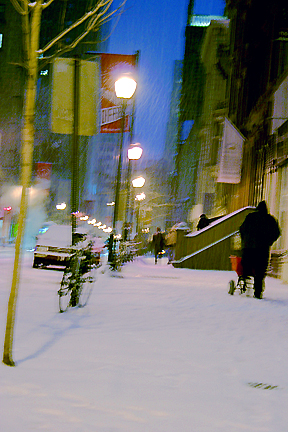 Street Bound photograph by author
“[A book about] 2nd chances, human connection, and the power of art and music.” — Steve Lopez, author and columnist, L.A. Times.
From NY’s Juilliard School to L.A.’s Skid Row
The Soloist, by author Steve Lopez, tells the real life story about how a relationship between a newspaper columnist and a Skid Row musician, Nathaniel Ayer, moves a city, a mayor, and this hardnosed journalist to help the homeless and mental health communities.
People responded to the daily columns about Nathaniel in unexpected numbers because Lopez broke the rules of journalism and let it get personal, Lopez told an audience of more than 150 people at Philadelphia’s Free Library last Saturday.
Lopez was candid, animated and well received. The author opted not to read from his book. Instead, he participated in a moderated Q&A before taking questions from the audience.
(The book is being made into a movie scheduled for release in theaters this November. Robert Downey, Jr. plays Lopez and Jamie Foxx plays Nathaniel. They are done filming, Lopez said.)
A main-character synopsis about how this complex and unlikely relationship unfolds and some of the more memorable quotes from the book discussion follow:
Steve Lopez
He used to be the hard-hitting columnist that kept Philadelphia’s city council in check before moving out to L.A, same job, different fodder.
This day’s prospective storyline: Rainwater stopping escalators and, in turn, repelling public commuters. L.A. tops the list for traffic congestion in U.S. cities. Locals are averse to public transportation as it is, so this escalator thing is a big deal.
While digging for the story near an underground station, Lopez hears a violin celebrating its glory. The man playing the instrument is an unlikely figure. The violin, Lopez notices, has two strings missing.
The man, he notes, is playing without a hat or an open violin case. So, why here, Lopez is compelled to ask.
There’s the Beethoven Statue. I play here for inspiration, Lopez recalls Nathaniel’s words.
For the first time in his career, Lopez abandons professional distance and surfaces in the foreign landscape of a schizophrenic savant living on Skid Row.
Nathaniel Ayer
Nathaniel studied with YoYo Ma as a fellow student at Juilliard School because of his innate confidence.
Ignoring his mentor’s advice, Nathaniel travels from Ohio to New York for the audition. Not only is he accepted, he receives a full scholarship.
Then, sometime during his junior year, elusive voices and images start toying with his reasoning. His condition deteriorating, Nathaniel finds himself out of school and in a hospital undergoing shock therapy. He eventually lands on the streets.
Decades later, in his 50’s, Nathaniel plays the violin near an underground station in Los Angeles, when a man approaches him. The musician does not know it, but his second chance just arrived.
(It was just easier, he would later say, to live on L.A’s Skid Row with thousands of homeless – heroin addicts, drug dealers, amputees, veterans – than to lose something again.)
The following are some of the more memorable excerpts (All quotes attributed to a third person are direct phrases by Mr. Lopez during his dialogue with the moderator and the audience.):
“Music is a balancing force in his life. Notes that for 200 years have not moved.” Music his Medicine – Disney Hall his Hospital – The Orchestra his Doctors. –Lopez
“Do musicians inspire you Mr. Lopez the way writers inspire me?” –Nathaniel (Addressing Lopez and launching into a well-versed soliloquy from Hamlet.)
“We are brothers. We are brothers in music.” –Yo Yo Mah (Addressing Nathanael backstage at Disney Hall; Nathanael, dressed in suit and tie, nervously wondered what he would say to YoYo Mah, Lopez said.)
“He has made choices in his life, and he is out there because he wants to be out there.” –-Nathaniel’s Father (Addressing Lopez, when Lopez tracked him down.)
“This chance encounter, this serendipitous moment on the street, has led to a 3-year relationship.” –Lopez
Comments Off on A Symbiotic Mulligan? Studied with YoYo Ma; Landed in Skid Row | tags: book, community, friendship, homeless, human connection, jamie foxx, juilliard, L.A., life, Lifestyle, los angelos, movie, Music, nathaniel ayer, new york, Personal, philadelphia, robert downey jr, second chances, skid row, steve lopez, story, the soloist, Thoughts, Travel, YoYo Ma | posted in Lifestyle, Music, Philadelphia, PA, Thoughts, Travelogue

photographs by author
Independence Mall, Philadelphia, PA; April 18, 2008; An observation and endorsement of “We the people…”
As the sun descends, I lay in the grass near Chestnut Street, the zenith of the long, downward-sloping expanse of Independence Mall. I can make out the prequel to a full moon under the blue sky; its depth washed out by the beach ball size, florescent flash emanating from the stage area several blocks ahead.
Meanwhile, families, students, and contented and forlorn locals of varied age and race continue converging on the green carpet separated by streets and walkways.
We wait for Barack Obama.
Imagine plays over the speakers: A performance from Live’s frontman Ed Kowalczyk. After a couple of solos, Will.I.Am, lead singer for the Black Eyed Peas, joins Kowalczyk in a rendition of Where is the Love.
As that anti-climatic moment wanes, we wait some more.
Pleasant enough, considering that Friday is enjoying its first warm spring day in Philly.
About an hour later, at 8:45 p.m., a cheer from the crowd, one of a string, but this one seems to linger. A microphone transmits Obama’s introduction. I start walking toward the stage and pass by the Liberty Bell.
Expectations are high after the speech he gave here last month, the one that now stands alongside the orations of Kennedy and M.L.K.
Absorbed by the encompassing bubble of bated hope and Obama’s words, I stop intermittently.
He speaks for 20-30 minutes.
He broaches a McCain presidency as more Bush policy, under new leadership. He addresses Clinton’s propensity to work within Washington’s fractured politics in contradiction to the new political stage he seeks to create. He cites our country’s economic, social, and military woes.
He does not say anything particularly brilliant. But it does not matter. His speech was earth shattering before he arrived.
Thirty-five thousand people, Obama’s largest audience to date, gathered on the land that birthed this country’s freedom for Friday night politics!
And in doing so, we expanded the footprint of our minds beyond our doorways.
We needn’t wait. But we did. And now our hopes and fears spill into 4 square blocks and trickle down the arteries.


2 Comments | tags: "national constitution center", "we the people", barack obama, culture, Hillary Cilnton, human connection, human nature, life, Lifestyle, live, news, obama, people, Personal, philadelphia, Photography, Politics, primary, story, street photography, Thoughts, Travel, travel blog, travelogues, writing | posted in Philadelphia, PA, Photography, Politics, Thoughts, Travelogue
Passing Through
The Walk
photographs by author
Tripping: Crossing Borders and Erasing Labels
Imagine it: A trip outside of your element...
In a liberated moment, you settle in as the curious explorer discovering indigenous culture. Meanwhile, without suspect, your mind sneaks in briefs of self-subscribed philosophy.
The new information clashes with sound bites from its memory chip: ** But the newscaster said**But my friend said**But the infamous "they" said**But the text stated**
Should you choose to engage your wit in a duel of ideas, keep one eye open that first night. Socrates may stop by with cigars in hand. No need to fret, freewill is his baby.
Note: 20-30% of U.S. citizens own passports. The numbers are disputed, but exploration does not require a flight ticket.
Comments Off on US Citizens w/o Passports | tags: life, Lifestyle, passport, Personal, philosophy, Photography, socrates, Thoughts, Travel, travel blog, travelogues, writing | posted in Lifestyle, Philadelphia, PA, Photography, Thoughts

Trafalgar Square Christmas Cheer
Photograph by author
It is January, not the best time to take a trip to London. The cold comes and goes; and on a good day, 45 degrees is not so bad if you dress properly. Of course, the first semi-warm day and I decide to “layer.”
It is my husband’s last night here. I have to make somewhat of an effort, don’t I? By which I mean: jeans, a hoodie, a jean jacket, and boots. But they are really cute jeans – the type that require 3-inch heels to accommodate the longer cut that impresses slendering height. And the hoodie is a purple, synthetic, snuggly fit Armani with an oversized hood and white detailing on the cuffs. I’m not a label whore, but that’s got to count for something…
After rearranging the contents of our bags, we head out around 3 pm. We begin our excursion at Trafalgar Square, all the while snapping pictures and trying to climb the lions. (Admit it – it’s sometimes fun to play the blatant tourist). Then, a quick “oohing and ahhing” at the 10 Downing Street entranceway, followed by a snack across the street.
At 5pm, we stop in for mass at St. Paul’s Cathedral.
The space feels blessed. Its cross-shaped intersection mends above the second largest freestanding dome in the world. On lookers and parishioners muse in the spirit of Christmas. Organs and reverberating hymns fill the cavity. The location has been a holy site since 604 A.D., although the edifice has been destroyed and reconstructed a handful of times; the latest design architected by Sir Christopher Wren, after the Great Fire of London.
As night falls, we go to Leicester Square. A carnival has pocketed the space for the holidays. Bumper cars, a giant rotating stick that looks like it has two spinning wheels on each end (complete with slack-jawed figurines), cotton candy, dinging bells, and popcorn air dance with our senses. Even the English have taken a break for the holidays, releasing the stick momentarily. We take a spin in the bumper cars. The cars are faster here and you can really feel the jerk upon impact, so we take another. This time, I drive.
We end the night at a cafe – a perfect day.
The Morning After
I wish I could say the same about the next morning, but I can’t. My body burned and pounded.Great – down with the flu on the first solo day of my trip. And I have to change hotels again – the downside of getting hooked up with friendly rates in decent accommodations. But I mustn’t complain. Otherwise, I would be on a plane home, with the dollar being in a more terrible way than I am at the moment.
After checking into my new accommodations, I head for the Indian restaurant across the street.
“May I please have some Dal?” I ask, as I rest my arms on the white tablecloth.
“And…” the waiter prompts.
“…and Nann, and make that a large Dal?”
He continues staring through me. “That’s it,” I squeeze out, “Look, I am sick, and I can’t eat anything else.”
“Then you’ll have to take it to go.”
“That’s fine,” I quip and shift into my chair sideways; my eyes blurring out the triptych of windows on either side of the restaurant’s facade.
“Hello,” I say instinctively to the only other customer in the room – a small, unassuming woman with silver hair and olive skin.
“Where are you from,” she asks, taking note of my accent.
“Philadelphia.”
“Why are you here – holiday?”
“No, I’m here searching out stories about South Asians in London. Their stories begin about a generation or so before that of South Asians stateside…thought it would be an interesting comparison. I am a writer,” I said in jumbled order. Hey, I am sick over here. She nods. “Actually, I would like to hear your story if that’s okay. Do you mind if I come sit with you for a moment?”
With that, my conversation with Joyce began.
1 Comment | tags: "the christmas carol", charles dickens, christmas, holidays, life, Lifestyle, london, Personal, Photography, story, Thoughts, trafalger square, Travel, travel blog, travelogues, UK, writing | posted in Lifestyle, London, England, Photography, travel
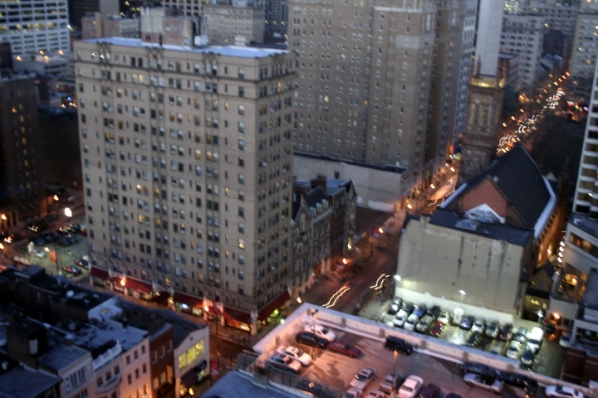
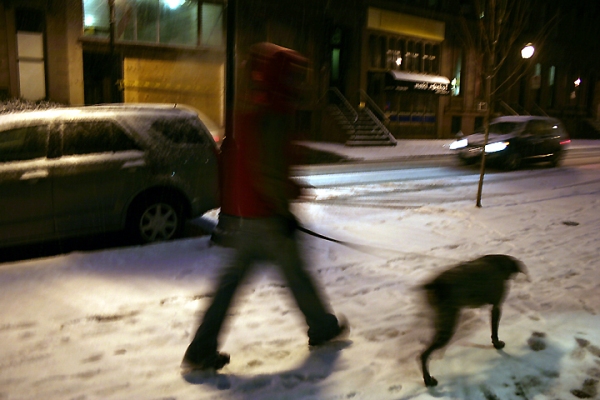
Philadelphia Winter 2007 by Pinkscript

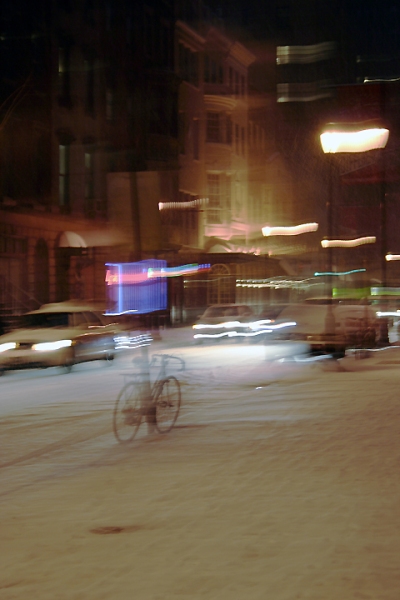
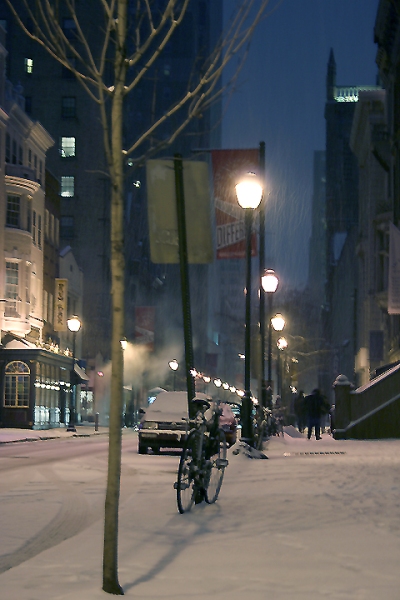
Comments Off on Photography – Blocks and Blurs | tags: buildings, graphics, life, Lifestyle, Personal, philadelphia, Photography, rittenhouse, Travel, travel blog, travelogues, winter photography | posted in Lifestyle, Philadelphia, PA, Photography, travel
Graphics by Pinkscript
A documentary initiated a trip to the Andy Warhol Museum in Pittsburgh, PA and provided the impetus in writing the following poem.
Tasting her wine in sweet surrender,
Sliding down her surface bender,
His upward glance tumbles down her silhouette.
Her perfect form stares him back without regret.
Stinging wounds find him lying in her salty pool,
Vaporizing before him, as time and water duel.
Suddenly it all makes sense.
Her flawless dress deems her less intense.
Dripping, he stands worrying only of the hour.
Fevering, he toils with drunken power.
Erecting glass houses, he crafts tomorrow.
His watchful eyes wet hers with all she can borrow.
Rinsing down to relief,
Her air perfumed in belief,
Hand in hand, they waltz in step out the door.
Slipping, he shrugs as she hits the floor.
She loses breath out of season,
Seeing anew the shades that colored her reason.
Kissing joy in change brought on by sorrow,
He smiles: No need to wallow.
I needed the amber in your wine to paint tomorrow.
Do you follow?
Comments Off on Warhol’s Wonderland | tags: culture, graphic art, life, Lifestyle, museum, Personal, philadelphia, Photography, pittsburgh, poem, Poetry, Recommend, Travel, travelogues, warhol, woman, writing | posted in Lifestyle, Philadelphia, PA, Photography, Poetry, Travelogue, World Culture

photograph by author
Haleakala Crater — a spell binding drive…
The sunrise at Haleakala Crater in Maui is at the top of “must see” tourist destinations. Being so close to the equator, the daylight is a 12-hour cycle, approximately 6 a.m. to 6 p.m. Not keen on the idea of getting up at 3:30 in the morning and splinting yourself with layers of clothing in preparation for wintry 30-degree temperatures? Then opt for a day trip, and enjoy it!
As we were reminded by the hotel staff, the sun’s glows play off of the clouds — the more clouds the more colors. So if you are an early riser, make sure the weather forecasters bet on dawn paying its dues. We chose to take the trip midday (less crowded). It was December — the height of the rainy season.
Horses lounged in the lush green grass — only expending energy to refuel. Turnabouts offered glimpses of an ocean haze beyond the expanse of undulating land. As we sloped around each new ridge, yellow rays wavered in silver-grey plumes. Green pastures gave way to dry brush and rock-strewn sediment. Clouds gushed and twirled in a hurried tempo. And the blue sky consumed it all.
An approaching storm broke the enchanted Alice in Wonderland spell. And we hauled ass on our descent. We never made it to the crater — pretty close though. Rent a convertible and the ethereal wind-up will unshackle your reality. The vastness of space alerts your senses. And, without hindrance, primary colors intersperse with their complements as the landscape cuts into the sky.
Comments Off on Haleakala, Maui: A Day Trip, Perhaps? | tags: guidebooks, haleakala, life, Lifestyle, Maui, open road, Personal, Photography, Recommend, story, Thoughts, Travel, travel blog, Travelogue, travelogues, writing | posted in Hawaii, Lifestyle, Maui, Photography, travel
Saturday August 11th — Curry Row, East Village, NYC
A Sensory Experience:
The evening breeze kissed my skin, and the aloof aroma of curry spices — cumin, chilies, coriander, and turmeric — tagged along to mingle with my palate in a courting ritual.
Window air-conditioning units hummed in sync with the casual swish of passing vehicles; their cadence occasionally jarred by a sudden jolt in RPM’s.
Samplings of Spanish, Chinese, and German dialects rhapsodized in the background alongside English tongues, some cloaked in European accents.
A female, rapping with alarming purpose, stole the lead. I pictured a celli smoldering her ear as her head bopped side-to-side in rhythm. Her lyrical crescendo: Don’t fuckin’ call me again!
Inspired by the scents and sounds of Curry Row, the above vignette was experienced with eyes shut. I recorded the moment while waiting for some friends.
And now the rest of the story…
During my conversation with the guy behind the bar at Brick Lane Curry House (I am pretty sure he was more than a bartender), I learned that the row experienced a significant downturn about 6 years ago.
Curry Row continues to reinvent itself, after a New York Times article, written several years ago, echoed public sentiment: All of the food seemed to come from the same kitchen.
Numerous restaurants went belly up, surrendering to new restaurateurs with niche vision. The makeover invited ethnic variety. Everything from Ethiopian to Chinese restaurants line the street today.
Brick Lane Curry House, serves dishes inspired by restaurants housed on the famed lane in East London. Keep an eye out for a restaurant review in Time Out New York (scheduled for print in September or October). My friends and I enjoyed the extra kick of heat and spices in our meals — British Style.
True foodies — like my friend who used to be a chef on the row — will probably argue the authenticity of the eats. But prices are reasonable and metered parking plentiful by Manhattan standards.
The guy at Brick Lane mentioned that 50% of the street’s patrons are international travelers who track down Curry Row with their handy guidebooks. No wonder I heard so many dialects on a small stretch of 6th Street that I suspected would be inundated with locals. So, if you are looking to drop in on an international scene (or an exotic tryst) — in a city that is already the ultimate melting pot — while eating a decent meal, Curry Row is a flavorful option.
Comments Off on East Village (NYC): Curry Tonight? | tags: Curry Row, east village, Food, life, Lifestyle, new york city, nyc, Personal, Recommend, restaurant, sensory, Thoughts, Travel, travel blog, Travelogue, travelogues, UK, vignettes, writing | posted in Food, Lifestyle, New York, NY, Recommend, travel, Travelogue, World Culture
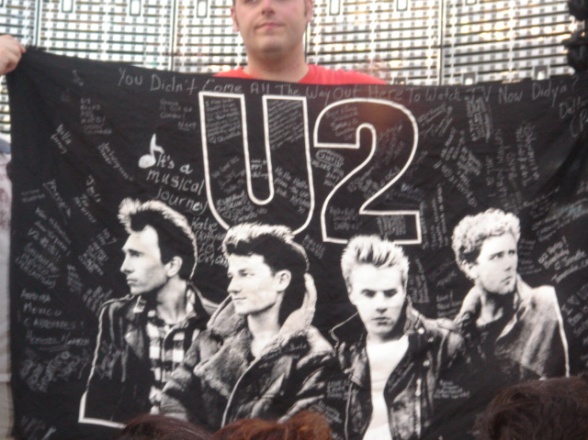
A look back in anticipation of the new album coming out in 2008 along with some nostalgia from seeing Bono speak at the Liberty Medal Ceremony in Philadelphia last week…
Upon arriving at Aloha Stadium in our ghetto Limo (adorned with duct tape and all), we head to the parking lot and retrieve our general admission wristbands — ensuring our spot in the coveted inner circle. We arrive at 2:00 pm, and several hundred of us swelter under blue skies until the gates opened at about 5:00 pm.
Once inside, the pre-game begins. Fans from Amsterdam, London, Italy, Australia, and yes, Philly too, exchange stories about preceding shows in the tour — playlists, performances, surprise guests.
People share food, alcohol, and contact info. etc. I end up swapping my cell battery with a guy from London. You see, his battery died, and he was waiting on an all-important text from a friend — a message that could take him backstage (and the desperate look on his face seemed genuine). How could I refuse?
The concert: We rocked out in total Elevation (yeah, I know) — U2, Pearl Jam, and a surprise appearance by Green Day’s front man, Billie Joe. I lost my voice for the next two days.
It sounds totally impractical to fly 12 hours for a concert, but it is hands down my best concert experience (and I’ve been to my share). The camaraderie, the excitement…it was pure euphoria! By the way — Jeremy Piven stood next to me during the show…no big thing (actually, it wasn’t because I did not watch Entourage).
Comments Off on U2 – Honolulu | tags: concert, life, Music, pearl jam, Personal, random, Thoughts, Travel, travel blog, Travelogue, U2, writing | posted in Hawaii, Music, Photography, Recommend, travel, Travelogue

Summer Zen -- Rittenhouse Park
photograph by author
Standing at the corner of Walnut and 19th Street, I watch as a Hugo Boss suit, French cuffs, Jimmy Choos, and Burberry Bags make their way up Walnut Street from the East. A Beatles tee, vintage jeans, Cargo shorts, and flip-flops make their way down from the West. They follow the perimeter of the square’s stonewalled entrance and cross into one of the park’s more ornate passageways alongside one another.
Located between University City and the swanky shops of Rittenhouse Row, the park and the city blocks flanking its perimeter share a symbiotic relationship that embodies the revitalization of Philadelphia and its residents.
The unique sense of community and artistic vibe Rittenhouse Park expresses has not gone unnoticed. In 2005, Robert Downey Sr., the namesake of his famous son, released the documentary, Rittenhouse Square. In the film, Downey expounds on the juxtaposition of the square and its’ residents. Urbanite, Jan Jacobs, has referred to the square as the perfect American neighborhood.
Crossing the street, I angle my way into the square’s urban refuge and notice the Hugo Boss suit. The man adorning it grins as a little boy, with his curly-brown locks tousling about, runs toward him. The spiky-haired guy in his Beatles tee swaggers toward a group of friends gathered around one of the many blankets dotting the grass.
The scene would put a smile on William Penn’s face, I imagine. During the late 17th century, Penn envisioned a city plan housing 5 park-squares, urban refuges, where people could congregate and share ideas. Adorned with Victorian architecture, residential high-rises, outdoor restaurants, pubs, specialty shops, hotels, bookstores, and the world famous Curtis Institute of Music, the surrounding bounty engages and attracts eclectic new acts that play harmoniously with its center-stage performance. Like a present-day Monet painting, the grounds capture the fluidity of color in style.
It is 6:00 p.m. on Friday. My husband and I are meeting at the park before getting together with some friends for a drink at Rouge. (The outdoor seating offers a front-row view of the park.)
Shaded by a bounty of trees, my strut shifts into an amble. I take a moment and inhale the scent of spring that permeates from the well-manicured gardens.
Fashionistas loiter about. A couple of twenty-something guys toss a Frisbee. An artist sets up his easel. Two women garbed in colorful Saris pass by.
Casting my eyes down one of the webbed walkways lined with benches, I see no sign of my husband near our usual bench. A call to his cell indicates he is on the other line. Brushing past a police officer (a normal presence in the park), I spot him near the reflecting pool. His eyes catch mine. He waves and puts up an index finger, indicating that he should be available within the minute.
Not holding my breath, I set my tote down on the nearest bench.
As I crack open my newly purchased Marian Keyes novel, the scurried activity of silver-haired men catches my eye. Preparing to engage in what I can only surmise to be the ultimate chess playoff, they set up three boards on three consecutive benches. Each player straddles the end of his respective concrete slab contemplating his attack. Their friends youthfully jostle about, keeping abreast of the action on all fronts.
With the strum of a guitar, my mind segues. Sure enough, it’s the dark-haired musician clad in his signature-black tee and jeans. As he plays, he checks out the scenery from atop a slab of concrete resting on columns that surround the plaza’s interior perimeter.
Having seen one another around, we both exchange a smile. Sitting in close proximity, our eyes rest on a homeless man with one arm stretched out over the reflecting pool. After a short pause, his arm unlocks, and he tosses a coin into the fountain. Once again the guitarist and I exchange a smile.
“Ready?” my husband asks.
“Let’s roll…”
1 Comment | tags: art, article, center city, liberty bell, life, Lifestyle, Music, parks, people, Personal, philadelphia, Photography, Rittenhouse Sqaure, story, Thoughts, Travel, travel blog, Travelogue, travelogues, Welcome, writing | posted in Lifestyle, Philadelphia, PA, Photography, Recommend, travel


 Travel Vibe

Raining: The Flipside of Down
Washington, D.C.
Rolling through high-heeled streets,
Shimmering in a photo finish.
Small drops with big ideas,
Ya make that steal, or merely cop a feel?
Too much cotton for mirrors on the flipside of down,
But soaking floats color.
So dragging the horizon like an ephemeral plea,
She teases air from smog.
Small drops, what’s the big idea?
She prays for din to break silence,
Before fancying a prey on thunder.
Pattering in gardens of brick and cities of grass,
She won’t ride lightening to wit,
Why take a bolt, when Sun owns color?
Glasgow, Scotland
San Diego, CA
Comments Off on Raining: The Flipside of Down | tags: commentary, Glasgow, human connection, human interest, human nature, life, Lifestyle, Personal, Photography, poem, Poetry, rain, san diego, story, street photography, Thoughts, Travel, travel blog, Travelogue, travelogues, washington dc, writing | posted in Lifestyle, Personal, travel, Travelogue